
reharmonise & restore
Tear trough filler
Also called: under-eye filler, periorbital filler, under-eye hollows treatment.
Tear trough filler at Dr Munroe Clinic restores volume in the hollow between the lower eyelid and the cheek, and may suit shadowing caused by that hollow. It does not treat puffiness caused by fat moving forward, loose lower eyelid skin or pigmentation, which are often the reasons the eyes look tired. Results usually last around nine to twelve months.


what it treats.
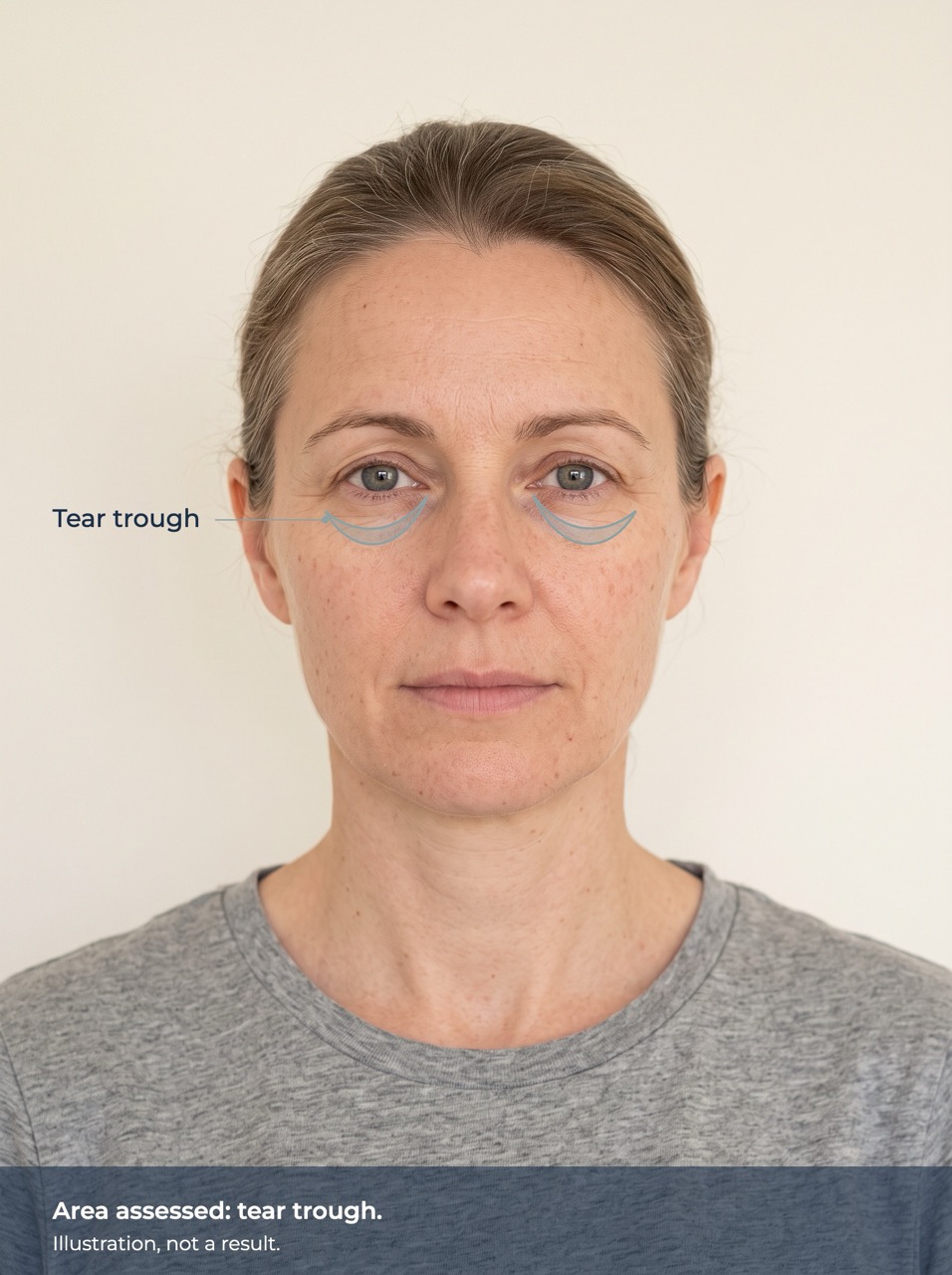
The tear trough is a defined anatomical structure: a ligament that runs from the inner corner of the eye along the bony rim of the eye socket. As the mid-face loses support, the skin above the ligament stays tethered while the tissue below it descends, and a groove forms. Filler placed deep beneath the groove can soften this transition.
what it doesn't treat.
Tear trough filler restores volume, so it will not change dark circles caused by pigment, and where the shadow comes from fat moving forward, filler placed beneath it can make the area look heavier. Where the skin is lax and crepey, filler can make this more noticeable rather than less. The cause is explained at consultation, and where filler is not the right treatment, alternatives are suggested.
the assessment.
Under-eye hollowing often reflects lost support in the cheek. The tear trough looks deeper when the mid-face has lost volume, so treating the trough alone can increase the contrast rather than soften it, and assessing both is usually the difference between a result that looks rested and one that looks 'done'.
The area also lies close to important blood vessels and nerves, and the skin here is the thinnest on the body. This shapes the technique: deep placement onto bone, small volumes, a cannula rather than a needle, and a product chosen because it attracts little water.
what happens on the day.
Following consultation, your concerns are discussed, the risks and side effects are explained and consent is taken before any treatment. Photographs are taken for the clinical record, and the entry point is marked with you seated naturally and the area cleansed. Topical anaesthetic is available, although many people find it unnecessary with a cannula, and the injection itself usually takes a few minutes on each side. The appointment takes around 45 minutes.
recovery.
Most people have little to show beyond a small mark where the cannula entered. Some people bruise and others do not, and this cannot be predicted in advance; when bruising does occur, it usually sits low enough to cover with concealer and clears within five to seven days. Swelling for 24 to 48 hours is common and can last longer under the eyes than elsewhere on the face.
There is minimal downtime and most people return straight to their day, although it is best to allow a few days before an important event. A follow-up review is available if a small adjustment is needed.
results.
Some improvement is often visible straight away, with the settled result usually reached by two weeks, which is when it is best judged. Results typically last around nine to twelve months, although hyaluronic acid in this area can remain for longer, which is part of why treatment is conservative and reviewed before any further treatment.
who it isn't for.
Treatment is not suitable during pregnancy or breastfeeding, where there is active skin infection at the site, where the lower eyelid is significantly lax, or where the under-eye appearance is caused by fat moving forward rather than volume loss. Autoimmune conditions and a history of filler complications are discussed individually.
price.
Prices are available on the price list.
common questions.
Is tear trough filler safe?
The under-eye is one of the higher-risk areas for filler because of its blood supply and thin skin. Risk is reduced through careful assessment, technique and product choice, although it cannot be removed entirely. The clinic holds the reversal agent on site, and Dr Munroe is trained in managing vascular complications.
Will it help my dark circles?
Only if the darkness is a shadow cast by a hollow. Pigment, and blood vessels showing through thin skin, need a different approach, which is worth establishing before any treatment.
Can it be dissolved?
Yes. Hyaluronic acid filler in this area can be dissolved if needed, and this is discussed at consultation.

Clinically reviewed by Dr Tiffany Munroe, MBBS MRCS, GMC 7293952.
Last reviewed . Next review .
About Dr Munroe